A Secret Agreement to Illicitly Tax the People
Open your dictionaries to the definition of 'collusion' (or if you're using Linux, macOS, or Windows and have the program curl in your PATH, open a terminal and call the command curl dict://dict.org/d:collusion).
My dictionary in the Edovo app returns:
Collusion [noun]
Definition: secret agreement
Go back just a little bit for the definition of collude, and you get:
Collude [verbs]
VERBS - conspire, collude
Definition: act in unison or agreement and in secret towards a deceitful or illegal purpose
Hi. I'm Jayel, one of the nearly two thousand 'residents' in this prison that will have its name changed to Blessington simply to offer me a little protection. And this:
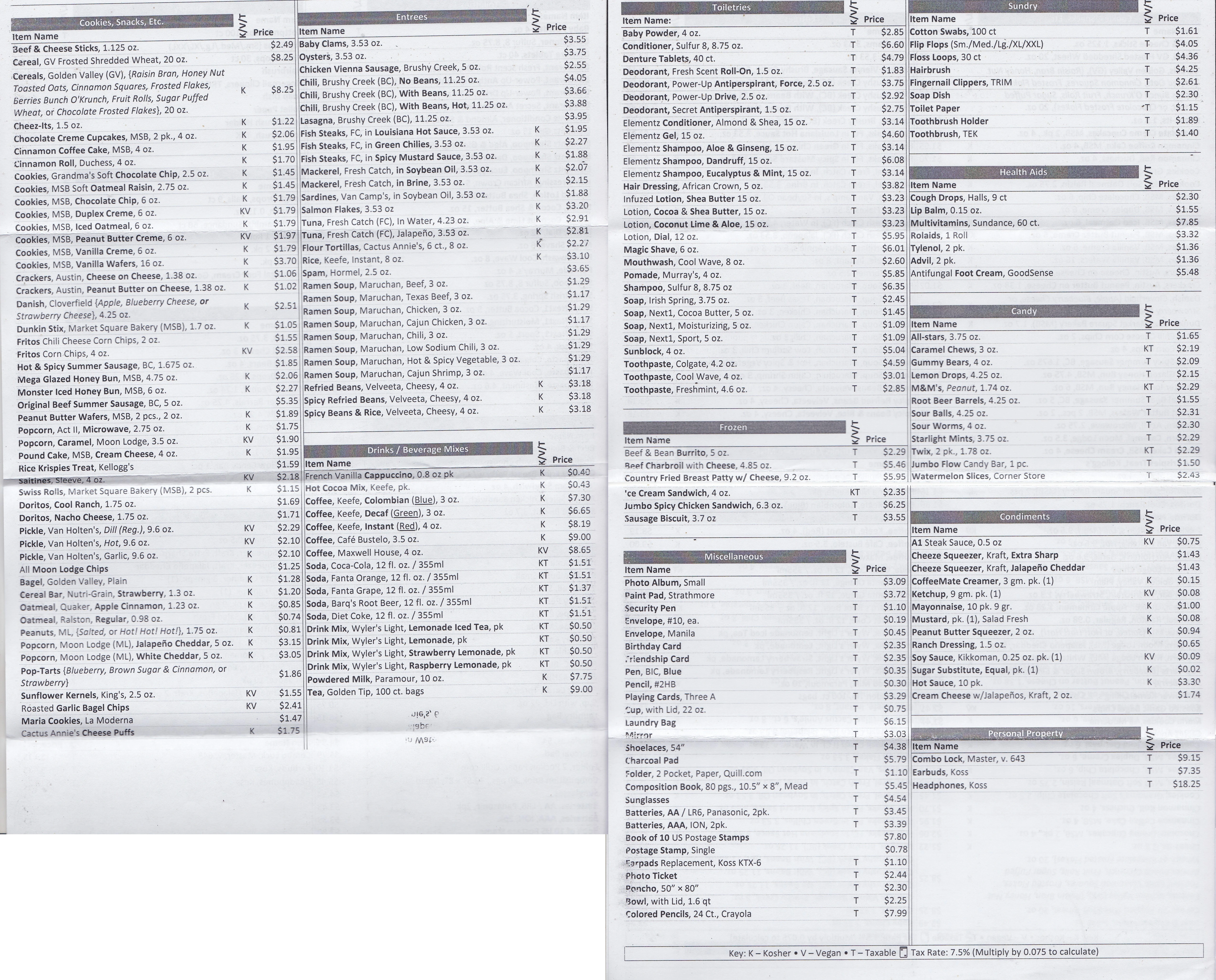
This menu was already out of date by the time I mailed it: prices on most edible items listed have increased by 10%, the maximum allowed twice per year. Our canteen provider here is the Keefe Commissary Network, whose owners are a company called HIG Capital.
An excerpt from the magazine News Inside, Issue 20, the article "The Big Business of Bad Prison Food" reads:
Part of the problem, critics say, is a conflict of interest: All three of the major private food providers also have a stake in the booming prison commissary business, where incarcerated people can buy staples like ramen, tuna and coffee, as well as chips, cookies and other snacks. In 2022, Aramark bought the commissary company Union Supply Group. Summit Correctional Services includes both food services and a commissary arm. Trinity is owned by the same private equity firm as Keefe, one of the dominant commissary companies. A Detroit Free Press columnist asked whether the Trinity-Keefe merger was "a motive to serve yucky meals"?
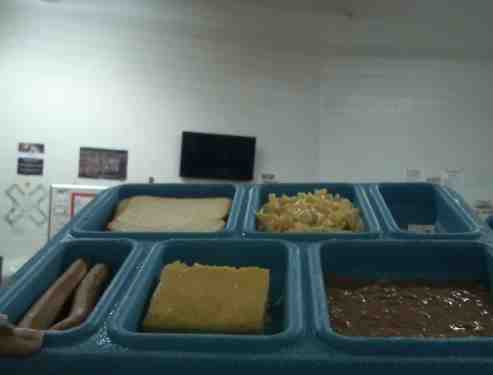
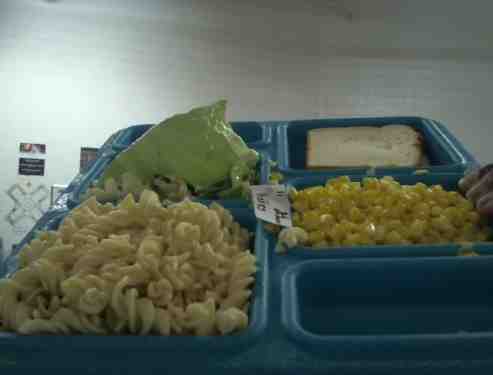
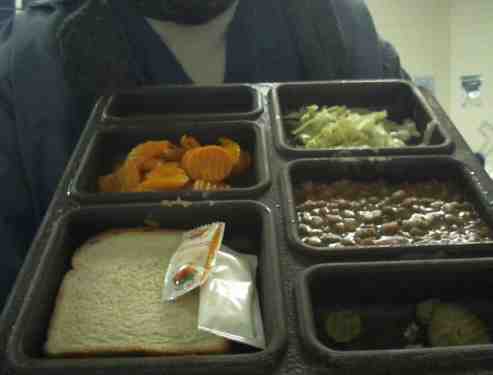
(Jayel uploaded yuktray1.jpg, yuktray2.jpg, yuktray3.jpg)
Poor food served in the chow hall drives hungry prisoners to the commissary, which only adds to the companies bottom lines, Croft, the Mississippi lawyer, told me. "Crappy food is being paid for twice. And then the state is paying for the medical care on that," she said.
These people, friends, are telling the truth, but are forced to shout it into a galestorm, a maelstrom of fecal chaff and flares used to distract your eyes away from the conditions happening in your small rural towns where many of Florida's prisons sit. Here in the panhandle, where I sit a an estimated leisurely half hour electric bicycle ride away from a city in Alabama, we are living through the effects of the Keefe-Trinity merger.
The meal tray photos above are taken with the potato of a camera on our in-dorm kiosks -- no questionable legality regarding how those photos left our prison, go viral with them if you'd like. We are provided meals (poorly) by Trinity, sold $1.41 Maruchan Ramen (I did mention a price increase above) by Keefe, and fed lines of fecal matter insisting that there's a "need" to increase the prices of everything because it's "so expensive" to get these basic gas station grade items that become necessity on this side of the fences.
Yet, many people here have been checking with their families and friends, who frequently report paying less than 30¢ for a single pack of ramen.
Can someone explain why our people are being taxed 450%+ to make sure we have something going into our stomachs when the State of Florida is obligated by law to ensure I have three meals per day?
Remember: spoiled food is not a meal, no matter how often you put it on a tray. It is a weapon, used to cause gastric distress in the form of food poisoning or worse. In the free world, restaurants are fined or even closed for lesser violations.
A Solution:
Here's what I wish to see:
FDC opens up sales to a limited selection (let's say 3 or 4) of outside vendors to let our people order customized monthly food packages from the outside. Have each vendor ship once on a designated week of the month, and bring the food packages to each dorm for delivery in the afternoons. This is modeled in part on what Keefe is already allowed to do for themselves only in state institutions (and won't offer to private camps), so it isn't a particularly notable deviation beyond adding companies like Walmart, Kroger, and Aldi (as examples) and vetting what food products and packaging for the food that they offer.
It is reasonable to say "No!" to glass bottles, bottles of Carolina Reaper sauce, tins of surstromming, and other foods that can be considered noxious or outright dangerous in our gated community. I get it in the name of security: you have sharp glass weapons, metal weapons, biological weapons (of both the noxious variety and nerve-attacking); Security has the duty to curtail things of this nature.
It's not reasonable to continue to expect that those who love us on the outside must bear an outsized expense when they buy us a $2.39, 4 ounce sleeve of saltines and a $1.03, 2 ounce packet of peanut butter. In the free world, a 16 oz. plastic jar of peanut butter can be had for under $3.00, and a 16 oz. box of saltines can be found for about the same amount, if the information I have in my head is accurate.
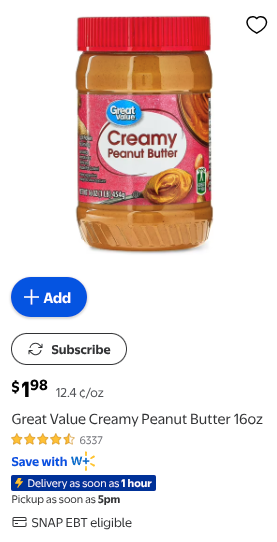
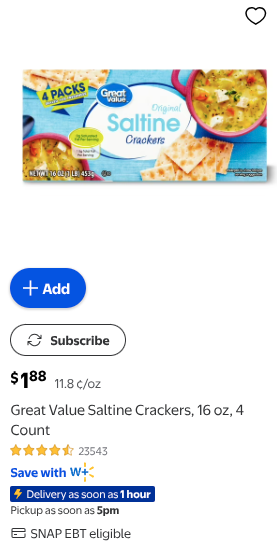
I can't see this picture, but you can. Take that statement multiple ways.
Let's find a way to fix this.
Please.